Walkthrough hub
Start with Chapter 1 and the systems pages, and stay out of Chapters 2 to 5 until you have played them. This site writes structure, not solutions: no culprit, no ending, no late-chapter twist.
This is the index for playing Psycho-Sleuth with a guide open, without having the game spoiled for you. It is a small hub because the site is small: one chapter walkthrough that stays inside what the demo already published, and a set of system pages you can read at any point without learning anything about the plot.
The spoiler rule
The site works on one line, and it is the first chapter.
Safe at any time: everything about systems, controls, prices, specs, languages, achievements, and the shape of the story. The number of chapters, the loop, the existence of a cult, the fact that each suspect has a disorder — none of that reveals who did it.
Not published here: the identity of any culprit, what happens in Chapters 3, 4 and 5, the ending, or which of the thirteen is lying about what. The developers have asked streamers to keep Chapters 4 and 5 offline until 13 November 2026 precisely because that is where the answers sit; a text guide has no excuse to be faster than the people making the game.
Chapter 1 is the exception, and only because the demo made it public in September 2025. Even there, this site describes what the first case asks you to do, not what it concludes.
What is covered where
| Chapter | Coverage on this site | Why |
|---|---|---|
| Chapter 1 | Full walkthrough — structure, controls, the two launch-week walls | The demo already published this chapter's opening case |
| Chapter 2 | Structure only: how the chapter is shaped, and the developers' own advice for demo players | Content beyond the opening is story |
| Chapter 3 | Structure only | Nothing specific has been published |
| Chapter 4 | Structure only, plus the streaming warning | The answers live here |
| Chapter 5 | Structure only | Same |
That table is short on purpose. A guide that fills every row with prose is either spoiling or padding, and neither is useful.
Three ways to read the site
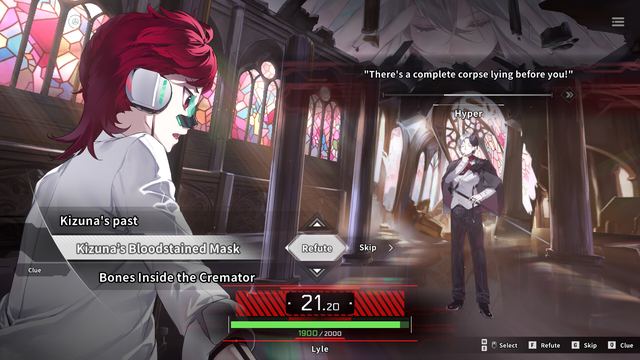
You have not started. Read what the game is and how debate mode works before you launch. Ten minutes of systems knowledge removes about an hour of fumbling in Chapter 1, because the game teaches its controls in a fight you can lose.
You are in Chapter 1 and stuck. Go straight to the Chapter 1 walkthrough. If something is behaving like a bug rather than a puzzle, known issues is the page with the softlock workaround.
You are past Chapter 1 and want systems help without story help. Pathosync and the afflicted powers explains what each disorder does to a room, which is the one piece of knowledge that makes the later debates tractable. It contains no plot.
How long each chapter runs
The developers put a full playthrough at about twenty hours across five chapters, which averages four hours each. In practice the split is uneven: the investigation sections stretch or shrink depending on how much you poke at the environment, and the trial sections are fixed-length arguments.
If you are trying to fit the game into evenings, a chapter is roughly one long sitting or two short ones. There is save anywhere, so you are not locked into a checkpoint when you stop mid-investigation.
What to do when a debate feels impossible
Nine times out of ten the problem is not the timer, it is the clue. A statement that sounds like a lie can be true — a suspect with spatial neglect honestly did not see the left half of the room — and the clue that breaks it is the one proving the object existed, not the one naming the person.
The second most common problem is hoarding. If you finish an argument with three unused clues, you were too conservative; if you finish with none and lost, you were too aggressive. The debate file goes through the decision rules properly.
If you are only here for the verdict
Then skip this hub entirely. Reviews and reception has the Steam and Metacritic numbers, and is it worth $17.99 argues the purchase both ways. The price file has the discount window, which matters more than any review if you are buying this month.
Chapter count and the playtime estimate are from the official streaming guidelines; the chapter-1 scope is from the demo's published coverage; the spoiler request is from the same guidelines. Checked 6 November 2026.
What a chapter actually costs you in time
The twenty-hour figure is an average, and averages hide the shape of a playthrough. Roughly speaking, a chapter breaks down like this:
| Section | Share of a chapter | Notes |
|---|---|---|
| Story and cutscenes | about a third | Fixed length, voice-acted, not skippable on a first run |
| Investigation | about a third | Elastic — stretches if you examine everything |
| Debate and trial | about a third | Fixed length, but retries add time |
The elastic third is where your playtime will diverge from the estimate. A player who walks a room once and moves on will finish closer to seventeen hours; a player who clicks every object and re-reads the log will pass twenty-five.
If you are stuck and it is not a bug
The most common non-bug wall in the first week is a debate where the right clue is in your list and you cannot see why it applies. Before you look anything up, do three things in order: open the profile of the person you are arguing with, re-read the statement you are trying to break, and check whether the clue proves the statement false or merely mentions the same object.
If that does not resolve it, the answer is almost always that you are arguing with the wrong statement. The game lets you refute a true statement and spend the clue; nothing stops you. That is why debates feel unfair before they feel hard.