Debate mode: accept, or strike back
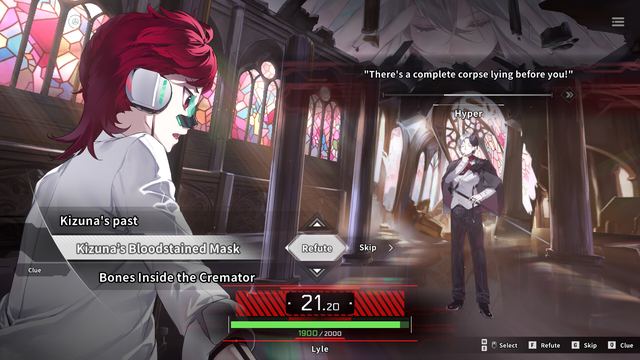
Debate Mode asks you to judge each statement in an argument: accept it, or strike back with the correct clue. A timer runs. You are scored on logic and time management, and the wrong clue wastes both.
Debate Mode is where Psycho-Sleuth stops being a reading game. Someone is talking at you, the statements stack up one at a time, and your only two options are to let a statement stand or to break it with a piece of evidence. Do it fast enough and the argument ends in your favour. Do it wrong and you have spent a clue for nothing while the clock keeps running.
The two verbs
Every debate is built from statements and clues. A statement is a claim made by the person across from you. A clue is something you picked up during the investigation. Your job is to match them.
- Accept — you let the statement pass. Sometimes this is correct: not every sentence is a lie, and treating a true statement as an attack wastes the argument's clock.
- Refute — you strike the statement down by producing the clue that contradicts it. This is the only way to advance a contested argument.
The design tension is that the game does not colour-code which statements are false. You are reading a person, not a UI. The store description is unusually honest about what is being tested: "logic, instincts, and time management" — three different skills, and the third one is the reason people lose.
The controls
The debate screen shows a statement list, a clue list and a timer. From the on-screen key hints in the Steam screenshots:
| Input | Action |
|---|---|
| W / S | Move the selection up and down |
| F | Refute the highlighted statement |
| Q | Open the clue tray |
| G | Skip ahead in the dialogue |
The exact binding can be rebound. The November 2025 demo update added hotkey customisation, so if F and Q do not suit your hand, remap them before your first trial rather than after.
One quality-of-life fix worth knowing: an early patch changed Q so that pressing it returns you to the main debate screen without making you re-select the evidence you had already chosen. If you played the demo in October 2025 and found the clue flow clunky, that specific annoyance was fixed.
Time is the real opponent
The timer is not decoration. There is a clock on the debate screen, clues cost you a moment to produce, and the wrong clue costs more than a moment — it costs the tempo of the exchange.
This is why the game feels harder than its puzzle logic actually is. The puzzles are fair; the pressure is not generous. A player who reads every statement twice and thinks before acting will out-perform a faster player who guesses at matches, even if the faster player is better at the underlying deduction.
The developers have adjusted this balance repeatedly. Patch notes across the demo's life mention refined debate pacing, tightened animation flow, and separately an extended timer in Truth Reconstruction Mode — the mode where you rebuild a sequence rather than argue a statement. They have tuned in the direction of giving players more room, not less.
Truth Reconstruction
Not every confrontation is a verbal argument. Some scenes ask you to rebuild what happened instead — arranging the pieces of a scene into the correct order. The Steam screenshots show a comic-panel layout with a card-placement control, and the patch notes refer to a timed Truth Reconstruction Mode with its own clock.
If the two are the same system, the implication is that you are assembling the murder as a sequence of drawn panels: who moved where, in what order, which panel contradicts which. It is a visual take on the same question the debates ask — what actually happened in this room — and it uses the game's comic framing rather than its dialogue.
What a miss costs
The game does not publish a damage model, and this site will not invent one. What is observable from the systems and the patch history:
| Situation | Effect |
|---|---|
| Wrong clue on a statement | The clue is spent on nothing; the clock keeps running |
| Accepting a false statement | The argument continues, but you have lost the initiative |
| Running out of time | The exchange resolves against you and you retry the section |
| Retrying | No penalty beyond re-reading; there is no lives system |
Retries are the safety net. Psycho-Sleuth is not a game that deletes your progress for losing an argument — it makes you sit through the scene again, which is punishment enough on a fourth attempt.
How to actually win an argument
Three habits, in order of how much time they save:
Read the person, not the sentence. Each Afflicted has a disorder that determines what they can and cannot perceive. A witness with spatial neglect is not lying when they say the left side of the room was empty; they simply did not see it. Statements that sound insane are usually the disorder talking, and the clue that breaks them is the one that proves the object existed.
Check what the clue proves, not what it mentions. A clue that names a person does not necessarily refute a statement about a place. The most common wasted clue is the one that feels thematically right and logically wrong.
Accept more than you think you should. New players refute everything, run out of clues and then lose to a true statement they cannot answer. Sometimes the correct move is to let three statements through and spend everything on the fourth.
Where this connects
The disorders that make statements unreliable are the subject of the Pathosync file — read that next if the debates are what you are stuck on, because the clue logic only makes sense once you know what each suspect is incapable of seeing.
If you are stuck on a specific argument rather than the system, known issues covers the Chapter 1 softlock, which is a bug rather than a skill problem.
Mechanics above are from the Steam store description, the on-screen control hints in the official screenshots, and the official demo patch notes from October and November 2025. Checked 6 November 2026.